sql-switch - v2.0.0
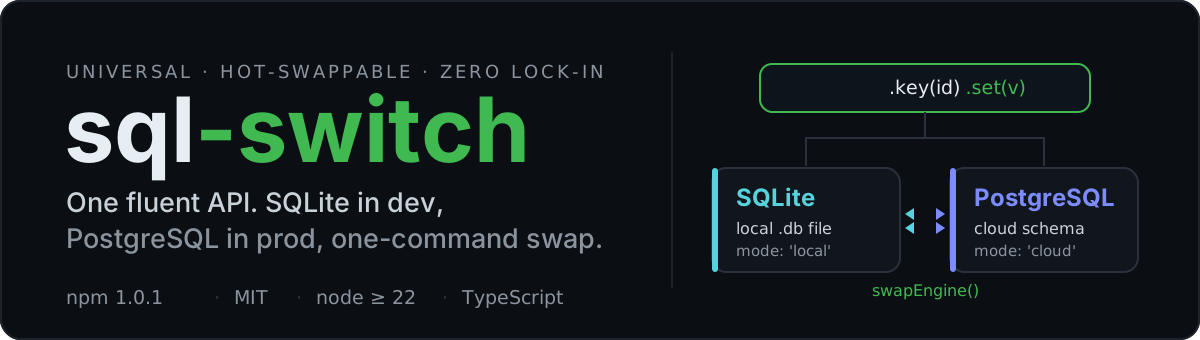


One fluent API for your data. Run SQLite while you build, PostgreSQL in production —
the same call works on both — then migrate between engines with a single command.
Quick start
npm install sql-switch better-sqlite3
import { sqlSwitch } from 'sql-switch';
const db = sqlSwitch();
await db.connect({
db: 'local',
local: { dataDir: './data/databases', wal: true },
collector: { enabled: true, time: 3000 },
});
// write — queued in RAM, flushed in bulk every 3s
await db.schema('antinuke').table('settings').key('guild_123').set({ strict: true });
// read — a queued write is visible to the next get() on the same key
const settings = await db.schema('antinuke').table('settings').key('guild_123').get();
// need it on disk right now? bypass the collector
await db.schema('antinuke').table('settings').key('guild_123').set({ strict: true }).force();
That is the whole surface: schema → table → key → operation. The same chain drives every engine.
Same code, production engine
Declare both engines up front and pick the active one with db — an env var is the usual
selector. Only the config changes; not one line of your data code does:
await db.connect({
db: process.env.DB_MODE ?? 'local', // 'local' | 'cloud'
local: { dataDir: './data/databases', wal: true },
cloud: {
connectionString: process.env.DATABASE_URL,
pool: { max: 5, statementTimeout: 30_000 },
},
collector: { enabled: true, time: 3000 },
});
Both declared blocks are validated at connect(), so a bad cloud connectionString is caught at
boot even while you're still running local. Flip engines at runtime — no data move, just repoint the
client — with db.reconnect('cloud'); use db.swapEngine() when the rows need to travel too.
In local mode each schema is its own .db file (./data/databases/antinuke.db, WAL on by default);
in cloud mode each schema is a Postgres logical schema (antinuke.settings). Your code never sees
the difference.
statementTimeout(default 30s,0disables) caps a single operation. Without one, a query that never answers holds a pool connection for the life of the process —maxof those and every later read blocks with no error at all.
The drivers are optional peer dependencies, loaded lazily the first time you connect() in that
mode — a SQLite-only app never pulls in pg, and vice versa. Install just the one you run:
npm install better-sqlite3 # local mode
npm install pg # cloud mode
Prefer the branded name? @creative-softworks/sql-switch re-exports this package unchanged.
How it works
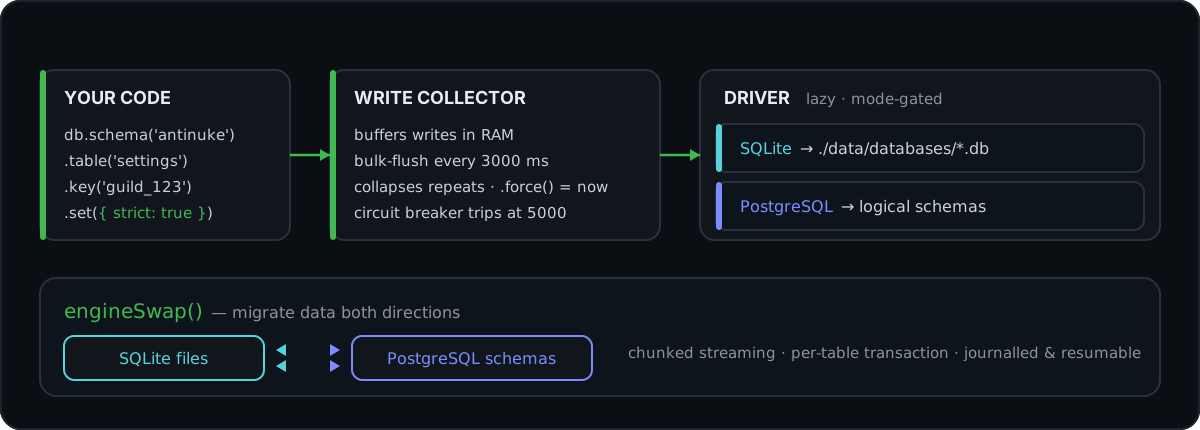
- Write collector — buffers writes in RAM and flushes them in bulk on an interval, collapsing
repeated writes to the same key inside the window.
.force()bypasses it for an immediate write. - Circuit breaker — caps pending writes at 5000 keys and trips to read-only on a Postgres outage instead of crashing, then heals itself once the database answers again.
- Exit flush —
SIGINT,SIGTERMandbeforeExitall drain the buffer on the way out; the library never callsprocess.exit()for you. - Engine swap — moves data both directions, a chunk at a time, journalled so an interrupted run resumes deterministically.
Enumerate, scan & convenience helpers
Beyond get/set/delete, a table streams and a key has the usual key-value sugar. The
enumeration methods return async iterators — a scan of a huge table never lands the whole thing in
RAM (a cursor on SQLite, keyset-paged on Postgres), so peak memory is one row/chunk.
const table = db.schema('economy').table('balances');
// stream keys / values / entries in ascending id order — break to stop early
for await (const [id, balance] of table.entries()) console.log(id, balance);
for await (const id of table.keys({ prefix: 'guild-' })) console.log(id);
// startsWith(prefix) is sugar for entries({ prefix }); the prefix is bound, never a pattern
for await (const [id, bal] of table.startsWith('guild-')) console.log(id, bal);
const howMany = await table.count({ prefix: 'guild-' }); // counted in the DB, rows never materialized
await table.deleteAll({ prefix: 'guild-' }); // wipe a prefix (or the whole table)
const key = db.schema('economy').table('balances').key('user_1');
await key.has(); // true if a value is stored (or buffered) for this key
await key.add(50); // numeric increment (a missing key counts as 0) → new total
await key.sub(10); // decrement
await key.push('a', 'b'); // array helpers: push / unshift / pop / shift / pull
await key.pull((x) => x.done);
Enumeration reads committed rows, so a write still sitting in the collector buffer is not visible to
a scan yet — await/.force() or close() first for an exact view. The numeric and array helpers
are read-modify-write and not atomic: two un-awaited add()s on the same key can read the same
base and lose an update. Sequential awaited calls are fine.
Reliability
Defaults are chosen so nothing is silently lost. All of it is configurable.
await db.connect({
db: 'cloud',
cloud: { connectionString: process.env.DATABASE_URL },
collector: {
time: 3000, // flush interval
autoRecover: true, // breaker heals itself after an outage
recoverAfter: 10_000, // read-only window before one trial flush decides
flushOnExit: true, // drain on SIGINT / SIGTERM / beforeExit
hooks: {
onStateChange: (state, reason) => log.warn(`db breaker ${state}`, reason),
},
},
});
| Behaviour | What happens |
|---|---|
| Buffered writes | A queued set() is visible to the next get() on the same key, before the flush. |
| Postgres outage | Transient failures are retried inside the driver with bounded jittered backoff; a group that still fails goes back in the buffer for the next flush. |
| Sustained outage | The buffer hits its 5000-key cap and the breaker opens — writes raise DatabaseUnavailableError, reads keep working. |
| Recovery | After recoverAfter the breaker half-opens; one trial flush closes it again (autoRecover: false keeps it latched until the process restarts). |
| Shutdown | SIGINT, SIGTERM and beforeExit flush the buffer, then the signal is handed back — the library never calls process.exit() for you. |
| Unstorable values | undefined, NaN/Infinity, NUL characters, BigInt and circular references throw InvalidValueError at the call, not inside a flush. |
Engine swap
Move your data between engines from the terminal or from code.
CLI
npm run db:engine-swap -- --up # local SQLite → production PostgreSQL
npm run db:engine-swap -- --down # production PostgreSQL → local SQLite
| Flag | Description |
|---|---|
--up / --down |
Direction. One is required. |
--url <conn> |
PostgreSQL connection string. Falls back to DATABASE_URL. |
--dir <path> |
SQLite data directory. Default ./data/databases. |
--keep |
Upward only: keep the local .db files instead of deleting them. |
--yes |
Auto-answer Y to every overwrite prompt (CI / non-interactive). |
From code
Anything you leave out is filled in — dataDir defaults to ./data/databases, connectionString
to process.env.DATABASE_URL, and missing schemas, tables and directories are created on the target.
import { engineSwap } from 'sql-switch';
const result = await engineSwap({
direction: 'up', // 'up' = SQLite → PostgreSQL, 'down' = the reverse
onConflict: 'overwrite', // default 'skip' — nothing is clobbered unless you say so
onProgress: (line) => console.log(line),
});
console.log(`${result.totalRows} rows across ${result.tables.length} tables`);
Or swap a live DAL and keep using the same object — pending writes are flushed and handles closed first, then it reconnects on the target engine with your existing collector settings:
await db.swapEngine({ direction: 'up', onConflict: 'overwrite' });
// same db instance, now reading from PostgreSQL
await db.schema('antinuke').table('settings').key('guild_123').get();
onConflict also takes a callback if you want to decide per target:
await engineSwap({
direction: 'up',
onConflict: (c) => c.schema !== 'economy', // never clobber economy
});
What the migration guarantees
| Guarantee | Detail |
|---|---|
| Memory | Rows stream a chunk at a time in both directions — peak memory is one chunk, not one table. |
| Atomicity | Each table moves in its own transaction going up; going down the file is built as .tmp and renamed into place. |
| Resume | Every committed table (or renamed file) is journalled in the data dir, so an interrupted run resumes deterministically. A clean run removes the journal. |
| Shared databases | Schema/table names this DAL can't address (^[a-zA-Z0-9_-]+$) are skipped and listed in result.skippedNames instead of aborting the run. Nothing else is read or written. |
| Interruption | SIGINT/SIGTERM stops at the next boundary, sets result.aborted, deletes nothing, then hands the signal back. Run the same swap again to finish it. |
| Local files | Deleted only when every table landed and no DAL in this process still has the data dir open — a write sitting in a collector buffer is invisible to a migration reading the file. |
const result = await engineSwap({ direction: 'up' });
if (result.aborted) console.warn('stopped early, rerun to resume');
if (result.skippedNames.length) console.warn('left alone:', result.skippedNames);
API
| Method | Description |
|---|---|
db.connect(config) |
Initialise the DAL. Call once at startup. |
.schema(name) |
Select a module schema (maps to a .db file or Postgres schema). |
.table(name) |
Select a table inside the schema. |
.key(id) |
Select a key inside the table. |
.get<T>() |
Read. Returns T | null. |
.set(value) |
Queue a write (or flush immediately if collector disabled). |
.set(value).force() |
Bypass the collector, write immediately. |
.delete() |
Delete immediately. Never queued, even when awaited without .force(). |
.has() |
true if a value is stored or buffered for the key. |
.add(n) / .sub(n) |
Numeric increment/decrement (missing key = 0). Non-atomic RMW. |
.push/.unshift/.pop/.shift/.pull |
Array helpers on the value. Non-atomic RMW. |
table.keys/.values/.entries |
Stream ids / values / [id, value], ascending id order. { prefix } narrows. |
table.startsWith(prefix) |
Sugar for .entries({ prefix }). Prefix is bound, never a pattern. |
table.count(opts?) |
Row count, done in the DB (rows never materialized). |
table.deleteAll(opts?) |
Delete every key (or just those under a prefix). |
db.reconnect(target?) |
Re-open the current engine (restart / recover a wedged connection), or repoint to the other declared engine ('local'/'cloud') without moving data. Flushes first; fail-safe. |
db.swapEngine(options) |
Migrate to the other engine & reconnect on it. |
db.pendingWrites |
Number of writes currently buffered in the collector. |
db.close() |
Flush pending writes and close all connections. |
engineSwap(options) |
Standalone engine swap, no DAL instance needed. |
Limits
The only hard wall you hit is the database running out of storage. The few non-storage constraints below are deliberate, so they're documented rather than left as surprises.
| Limit | Detail |
|---|---|
| Big integers in values | Values round-trip through JSON, so an integer past 2^53 loses precision (12345678901234567890 reads back as …567000). Store big integers as strings. Only the key is precision-safe. |
| Binary in values | A Buffer/typed array serializes to { "type": "Buffer", "data": [...] } and comes back a plain object, never a Buffer. Base64-encode binary yourself if you need it back intact. |
| Unstorable values | undefined, NaN/Infinity, NUL characters, BigInt and circular references are refused up front with InvalidValueError — they can't be stored the same way by both engines. |
| SQLite schema count | In local mode each schema is one .db file whose handle is cached for the life of the process (no LRU). Keep schemas coarse — one per module (antinuke, economy), not one per entity — or a schema-per-tenant layout hits the OS file-descriptor limit long before disk fills. Put the entity id in the key, not the schema. Cloud mode shares one pool and has no such ceiling. |
| SQLite writers | WAL allows concurrent readers with one writer. A second writer process waits up to busyTimeout (default 5s) for the lock, then throws SQLITE_BUSY. In-process, one cached handle per schema serializes writes already. |
Scripts
npm run build # dual CJS/ESM bundle + per-file .d.ts
npm test # Vitest suite (Postgres files skip themselves without DATABASE_URL)
npm run typecheck # tsc on src/ and scripts/
npm run smoke # fast end to end check against real SQLite files
npm run swap-test # engine swap integration test (needs DATABASE_URL, skips without it)
npm run docs # TypeDoc HTML into /docs
npm run docs:serve # serve /docs on http://localhost:3000
Requirements
- Node.js >= 22.0.0 (tested on the active LTS / current lines, 22 and 24)